Last week, while lining up six Westport 112 listings, two early-2000s boats, three mid-2010s, and one post-2018 refit, one spread made me pause. The 2011 example with a recent mechanical and interior refresh was edging close to a newer hull’s ask, while an older, shiny-from-afar 2003 sat stubbornly high. It reminded me how the used Westport 112 price isn’t just about the year on the transom: it’s hours, refits, and the quiet engineering choices that age gracefully (or don’t) below the parquet.
Westport 112 Used Price Range (2025)
In 2025, the used Westport 112 price typically sits in a broad but predictable band once you match year, engine hours, and refit status. What I’m seeing across U.S. and Mediterranean markets:
Early 2000s (2001–2006): commonly US$ 4.2 M–5.4 M, with well-kept, recently updated examples creeping to ~US$ 5.8 M.
Late 2000s to early 2010s (2007–2013): often US$ 5.8 M–7.8 M, depending on hours and zero-speed stabilization.
Mid-2010s to late-2010s (2014–2019): typically US$ 7.8 M–10.5 M, with low-hour, tastefully refit boats toward the upper end.
2020+ builds (when available pre-owned): can push US$ 10.5 M–12 M+ if late-model, low-hour, and highly optioned.
These are asking ranges; sold numbers tell the truer story. Condition, mechanical currency (coolers, injectors, turbos, gens), and whether the boat has zero-speed stabilization often swing value by six figures.
Asking vs Sold Prices
Asking prices on Westport 112s tend to carry a 6–12% cushion in the U.S. market and sometimes 8–14% in the Med, especially at the start of the season. Well-presented boats with current surveys, recent bottoms, and complete engine service history narrow that gap.
Where I’ve seen bigger spreads: older interiors that feel dark by today’s standards, deferred teak replacement, or dated bridges with legacy navigation suites. A clean, well-documented 2012 with sub-4,000 hours can transact within 5–7% of ask; a 2003 with 7,000+ hours and only cosmetic refresh may land 12–18% below initial ask, especially if major mechanicals loom.
Market Trends for Westport 112 Used
U.S. vs Med: The U.S. usually holds a slight pricing premium because of Westport’s strong service network. The Med market, while sometimes offering lower asking prices, often demands more refit work.
Seasonality: Spring asks often rise 2–4% as sellers test demand; late Q4 can produce calmer negotiations as winter berths and insurance renewals nudge deals.
Specification gravity: Zero-speed fins, modernized nav/comm suites, and clean engine rooms consistently support value. Boats lacking those tend to linger.
Macro: The broader 100–120 ft composite motoryacht segment has cooled a little from the 2021–2022 peak, but quality, documented maintenance, and tasteful modernization are still winning.
Depreciation & What Holds Value
The Westport 112’s depreciation curve is gentler than many peers, thanks to its proven composite construction and strong builder reputation. Early-year depreciation is often 10–15% in the first year, then gradually flattens. By the 10–15 year mark, the curve depends more on maintenance and refit cadence than the calendar.
Impact of Year, Refits, and Engines
Year: Later hulls usually carry updated systems and lighter interior palettes—but a strong refit can allow an older hull to punch above its year.
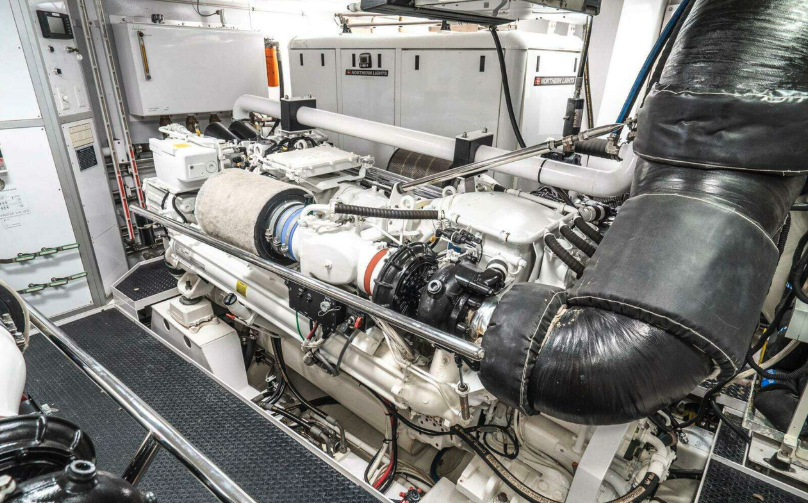
Engines: Many 112s run MTU 16V2000 series; earlier M90 variants usually price lower than more modern M94 or common-rail versions. Hour bands are meaningful: sub-3,500 hours commands a premium, 4,000–6,000 is typical, while >6,000 invites close scrutiny. Spec sheets from MTU’s official documentation detail how performance and service intervals vary with each version of their 16V-2000 engines.
Refits: Stability upgrades (zero-speed fins), refreshed navigation (Furuno/Garmin), modern AV/IT, teak or exterior paint, and interior tone refreshes all materially support value. A full refit of the most critical systems often shows up as a strong negotiating point.
Features That Retain Value
Stabilization: Zero-speed fins are nearly essential on this class; retrofits frequently add US$ 200K–350K, in my experience.
Gensets & Electrical: Recent generator service or replacement, clean switchboards, and well-run cabling anchor buyer trust.
Tenders & Toys: A modern tender helps, but outdated cranes or davits can drag on resale.
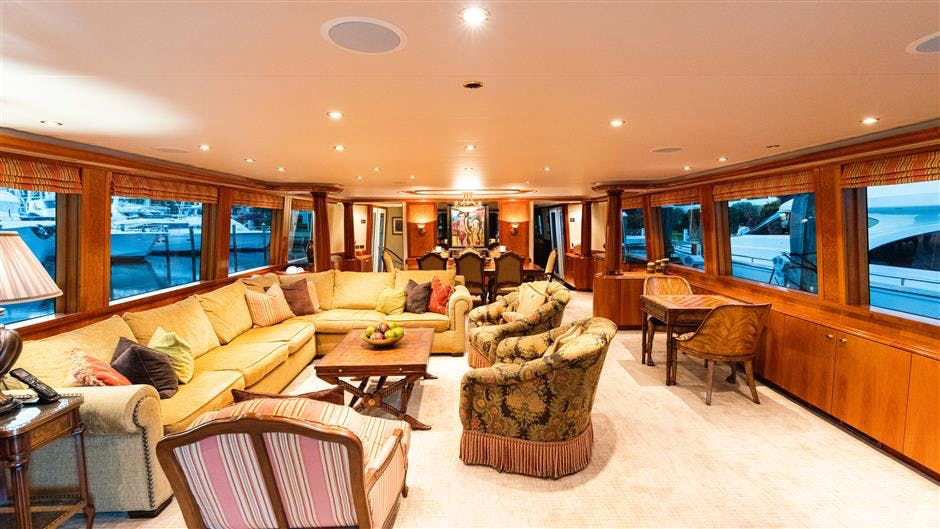
Interior Tone: Westport’s later lighter palettes photograph beautifully; well-executed LED upgrades and sound-insulation tweaks (floor, door seals) matter.
Documentation: Engines, fluids, interval service logs, and survey reports are more powerful on paper than almost anything else when justifying a premium.
Ownership Cost Snapshot
I like to map out a realistic budget for a well-used Westport 112 operating in common U.S. cruising areas (East Coast, Bahamas):
Annual Maintenance & Fuel: Routine service $150K–250K; heavy refit years can go into $150K–300K additional. Fuel burn at 19–21 kt cruise is ~140–180 gph, roughly $120K–$250K/year in fuel, plus spares/consumables at $25K–$50K.
Crew / Insurance / Dockage: Four-person crew usually runs $260K–$380K. Insurance is around 0.6–1.2% of hull value. Dockage/berthing costs vary, often in the region of $700–$1,500/ft/year depending on marina.
A calm but realistic all-in operating budget: US$ 500K–900K annually, before major refits or repositioning.
Survey & Structural Inspection
Beyond just the price tag, three inspection areas make or break underwriting the value: structure, machinery, and modernization:
Composite health: Inspect moisture levels, core bond integrity, and past repair quality under penetrations (hatches, through-hulls).
Deck / House: Teak thickness, fastener security, soft spots, window bedding, and door seal integrity.
Engine Hours & Maintenance Records
MTU Intervals: Confirm services on aftercoolers, injectors, turbos, valve adjustments, and genset load history. Oil and vibration analysis help build trust.
Gensets: Track hours, load patterns, rewinds, and full overhauls.
Cooling / HVAC: Chillers and air-handlers should be current and recently serviced—those are often overlooked.
Refit & Upgrade Priorities (My Buyer Framework)
If I were advising a buyer:
Add zero-speed fins if not already fitted.
Modernize nav / bridge (budget $100K–$250K depending on suite).
Upgrade AV / IT with hardwired mesh Wi-Fi.
Consider exterior paint or teak refresh ($400K–$700K+ for full hull).
Refresh interior tone: lighting, soft goods, stone surfaces.
My rule of thumb: survey-grade systems (engines, generator, stabilizer, electrics) first; aesthetics second.
Talk to a Specialist
If you’re serious about a Westport 112, the conversation should probably start with hour-banded comps, survey reports, and refit histories. Ask brokers for a 6–12% haircut on ask if the refit is cosmetic-only. Prioritize mechanical transparency — that’s where I see real value retention.
Frequently Asked Questions
What’s a typical used Westport 112 price? Early 2000s: $4.2M–5.4M (up to ~$5.8M if well refreshed) 2007–2013: $5.8M–7.8M 2014–2019: $7.8M–10.5M 2020+: $10.5M–12M+ (rare)
How big is the ask vs sold adjustment? United States: ~6–12%; Mediterranean: ~8–14% depending on refit, engine hours, and documentation.
Which upgrades matter most? Zero-speed stabilization, recent MTU service, refreshed generators, and clean engineering spaces. Interiors and paint come second, but strong refits always anchor to structure and systems first.