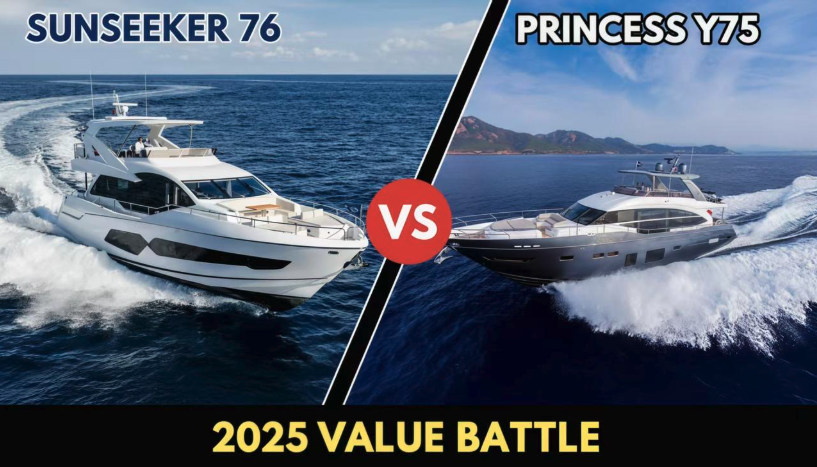
While comparing Mediterranean and U.S. listings this week, a small contrast caught my eye. A Sunseeker 76 and a Princess Y75—similarly equipped and priced within $100,000—told two different stories once I looked past the headlines. The Sunseeker offered almost 20% more beam volume; the Princess carried 300 fewer engine hours and a quieter, more polished interior feel.
It’s a gentle reminder of how these boats compete in the real world: space on one side, refinement on the other, with price tracing those differences closely. Here’s how I’d weigh Sunseeker 76 vs Princess Y75 for 2025.
Sunseeker 76 vs Princess Y75: At-a-Glance Comparison
Both sit in the sweet spot for owner-operator plus crew. The Sunseeker 76 (launched circa 2018) feels newer as a nameplate, with bigger volume and a sportier stance: the Princess Y75 (2016–2020 build years commonly on market) leans toward quiet ride quality and polished ergonomics.
Typical asking prices (2025):
Sunseeker 76: usually $3.2M–$4.3M depending on year (’18–’23), hours, and stabilizers.
Princess Y75: often $2.6M–$3.6M depending on year (’16–’20), hours, and refits.
Beam and volume:
Sunseeker 76 beam ~6.0 m (about 20 ft). Noticeably more interior volume and flybridge area.
Princess Y75 beam ~5.76 m (about 19 ft). Slightly narrower, translating into a sleeker feel and marginally lower windage.
Stabilizers: Both were commonly specified with fins or gyros: fin packages generally command stronger resale on these sizes.
Price and Value Comparison
Late-model 76s with MAN V12 1900s and fins often sit around $3.8M–$4.3M asking in the Med: U.S. boats can ask a touch higher if low-hour and turn-key. Earlier Y75s (’16–’17) with MAN 1800s and fins typically list $2.6M–$3.1M: the nicer ’18–’20 examples can push $3.2M–$3.6M. The gap reflects age and volume more than brand premium. In simple terms: the Sunseeker 76 costs more because it’s newer as a model and bigger inside: the Princess Y75 counters with calmer ride manners and a gentler entry price.
Performance and Handling Breakdown
On the water, these two feel related but not identical. The Y75, with Olesinski hull DNA, tends to read a touch softer in a head sea, especially around 18–22 knots where many owners cruise. The Sunseeker 76 tracks confidently and carries speed well: the extra beam helps at rest and at anchor, especially with fins active.
In my notes from a choppy afternoon off Palma, a well-kept Y75 held an easy 20-knot cruise with lower creaks and fewer cabinet murmurs than I expected for the age. A 76 I ran in the Solent felt more planted at rest and gave a bolder flybridge social zone, useful when you’ve got six up top and a long lunch planned.
Engine Options and Top-Speed Differences
Sunseeker 76: commonly MAN V12 1900s. Top speed typically 30–34 knots depending on load and sea state: happy cruise 22–26 knots.
Princess Y75: often MAN V12 1800s. Top speed around 31–34 knots: cruise 21–25 knots.
Real-world difference: negligible at the top end: the story is more about ride character. The Princess often feels a fraction quieter underway: the Sunseeker often feels more stable at anchor and when guests roam the flybridge. Propellers, gyro vs fins, and load planning make more difference than brochure speeds here.
Design and Layout Comparison
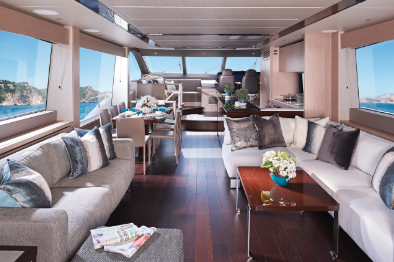
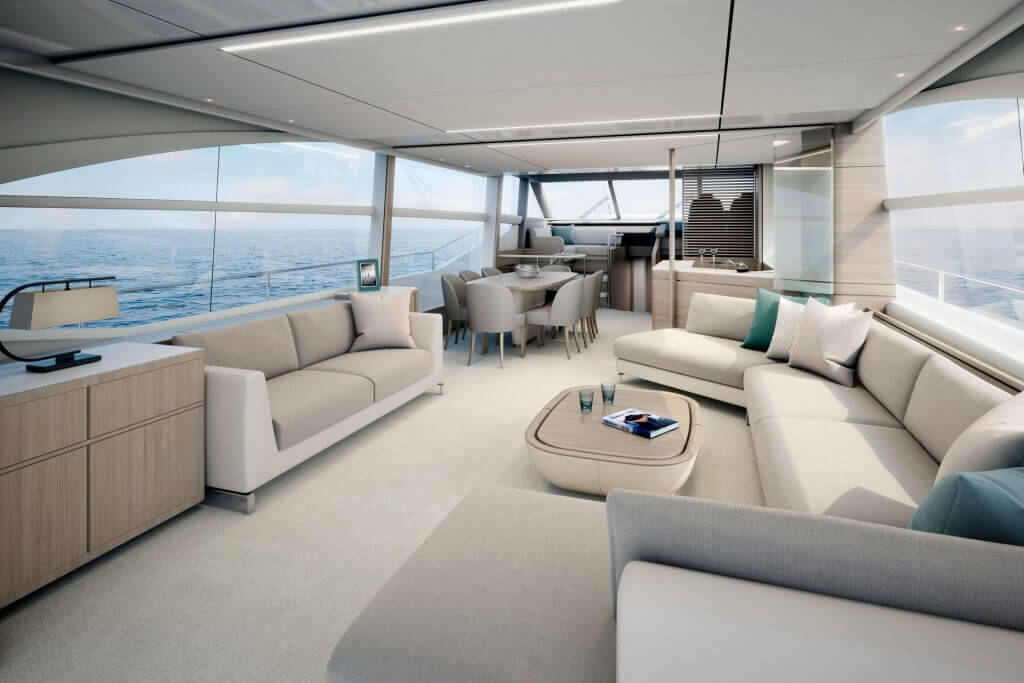
The Sunseeker 76 carries its volume through the main deck and flybridge, giving you a larger salon footprint and a generous aft deck-to-beach-club flow. The Princess Y75 wins on finish continuity and whispery door hardware, the small touches that feel expensive every time you move around the boat.
Below, both offer four cabins with a proper full-beam owner’s suite and crew aft. The 76’s owner’s cabin tends to feel wider with bigger nightstand margins: the Y75’s lighting design and joinery read slightly more refined.
Flybridge Space and Interior Configuration
Flybridge: The 76’s FB is the social hero, more seating runs, often a larger wet bar, and sunpad zones that don’t crowd the helm. If you host often, this matters. The Y75’s flybridge feels curated and protected, with excellent sightlines from the upper helm and a calmer wind profile.
Interior: Many 76s were specified “galley up” with strong indoor-outdoor flow: Princess interior schemes lean airy and balanced, with superior door seals and subtle sound damping. I pay attention to latch feel and floor resonance under dine-in traffic, Princess is exceptionally consistent here.
Foredeck: Both offer usable lounging: the Sunseeker’s beam gives slightly more elbow room, while the Princess tends to integrate backrests and handholds with a cleaner aesthetic.
Annual Running Costs: Sunseeker 76 vs Princess Y75
Running costs converge more than many expect. For a 75–76 ft planing flybridge in active use:
Annual maintenance and routine service: typically $80K–$130K, assuming MAN services, anodes, bottom, and minor cosmetic work.
Crew: captain-plus-stew/deck typically $120K–$180K all-in, depending on region and rotation.
Insurance: usually 0.7%–1.0% of hull value: newer 76s might see $28K–$40K, while older Y75s often $20K–$32K.
Mooring: Med 24m berths commonly €40K–€80K: prime marinas command more. U.S. East Coast varies widely, $25K–$60K.
Fuel: at 21–24 knots, plan roughly 260–330 L/hr (70–87 gph) combined, load and sea state dependent.
Stabilizers matter for maintenance planning: fins bring periodic seal/bearing work: gyros require scheduled service hours. Neither is a reason to avoid, just budget consciously.
Which 75-Foot Yacht Offers Better Value in 2025?
Value depends on your brief. If you want newer-year boats with bigger interior volume and a flagship flybridge feel, the Sunseeker 76 earns its premium. If you prioritize ride softness, lower cabin noise, and an easier on-ramp price, the Princess Y75 is very hard to beat.
Depreciation logic I’m seeing:
Early years: ~10%–14% over the first 24–36 months from new (model-dependent, spec-sensitive).
Stabilized years: 5%–7% annually, then flattening as the market normalizes around condition and hours.
Hour bands matter more than badges. Sub-600 hours feels “prime.” 800–1,200 hours is the range where I ask buyers to slow down and lean into surveys, cooling systems, exhaust lagging, steering rams, and stabilizer service histories tell the real story. A 2018 Sunseeker 76 with 500 hours, fins, and updated electronics can justify a stronger ask than a 2016 Y75 with 1,200 hours and deferred soft-goods, yet a 2019 Y75 that’s been consistently serviced can close that gap quickly.
Regional notes:
Med: More selection, slightly firmer pricing on highly spec’d 76s: Y75s move when turnkey for the season.
U.S.: Fewer but cleaner-hour examples: shipping and voltage conversions can tilt the math.
Asia: Attractive pricing on occasional corporate or lightly used boats, but plan logistics for surveys and post-purchase support.
My buyer’s shorthand: entertainers and families who live on the flybridge gravitate to the 76: long-range weekenders who prize quiet cabins tend to love the Y75.
Request Quotes for the Sunseeker 76 and Princess Y75
If you’d like current ask vs. achieved price data for your region, I’m happy to pull a live set of comps, days on market, hour bands, stabilizer type, refit notes, and survey flags. Tell me your preferred year range, cruising region, and target spec (fins vs gyro, MAN rating, hardtop, crew layout). I’ll return apples-to-apples quotes and a shortlist of listings worth boarding. One dependable principle: buy the cleaner hull and the calmer survey, even if it isn’t the cheapest sticker.
If you’re in the mood for more, here are a few posts you might enjoy next.