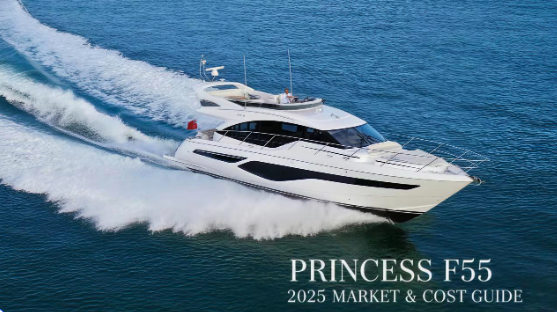
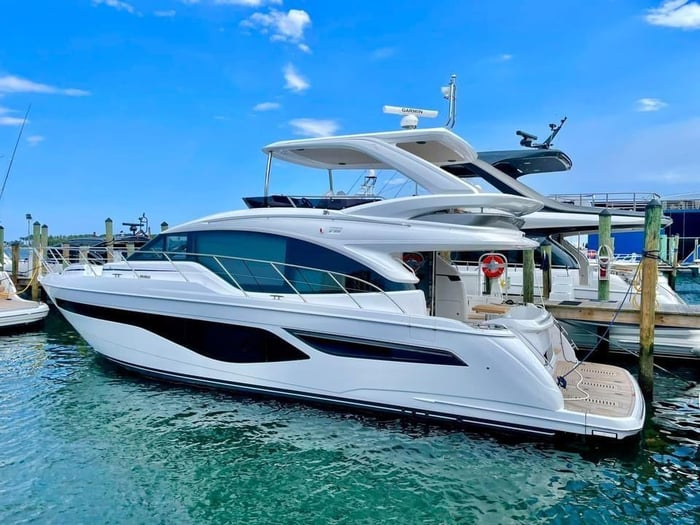
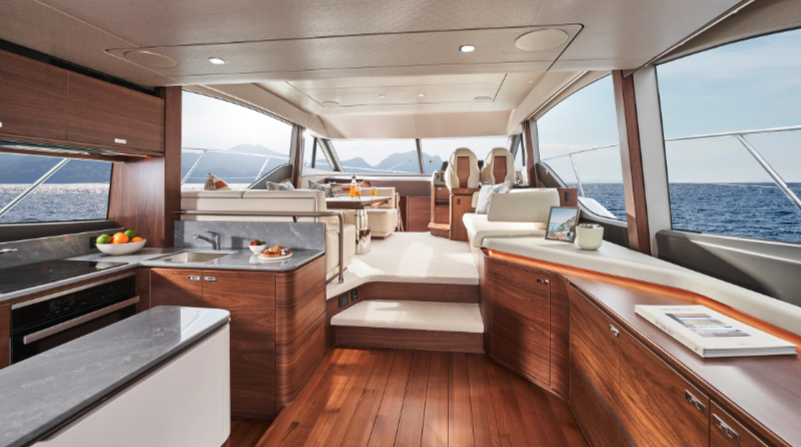
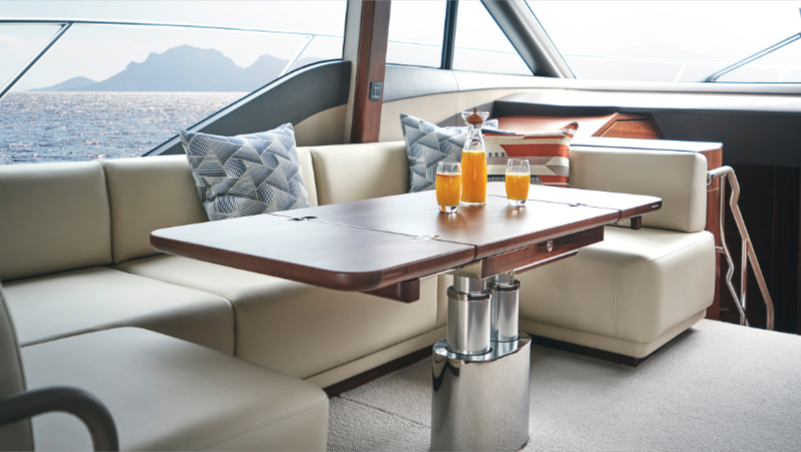
While comparing Princess F55 listings last week, I noticed something quiet but telling—the pricing spread between Mediterranean and U.S. markets has widened, and it’s less about currency than specification depth.
The Princess F55, introduced in 2017, occupies a thoughtful position in Princess Yachts’ F Series flybridge range. It’s a yacht that balances spacious entertaining areas with genuine cruising capability, wrapped in the refined British craftsmanship Plymouth has been known for since 1965.
Princess F55 Price Overview (2025 Market Data)
The Princess F55 typically ranges between $2.8M and $3.6M for a new build in 2025.
Mediterranean listings often sit around €2.6M–€3.2M, translating to the upper dollar bracket once VAT and delivery logistics are factored in. U.S.-based builds through authorized dealers lean toward $3.0M–$3.5M for well-optioned examples with extended warranties.
Used models from 2020–2023 fall between $2.2M and $2.9M.
The tightest pricing clusters around 2021–2022 boats that benefited from updated helm electronics and the revised bridge deck layout. Earlier examples—2018–2019—can dip below $2.0M if engine hours are moderate and the interior shows light use, though those are becoming harder to find.
What Drives the Range?
Mostly spec depth.
A Princess F55 with upgraded Volvo IPS engines, extended teak decking, premium audio, and a custom galley will sit at the top. A more conservatively optioned boat with standard finishes lands closer to the middle.
Regional demand matters too. The F55 holds stronger in northern Europe and the U.S. East Coast, where its size suits both weekending and extended coastal cruising. In Asia-Pacific markets, where larger flybridge models dominate, you’ll see slightly softer pricing on used inventory.
One thing I always check when comparing listings: whether stabilizers, generators, and air conditioning are standard or listed as options. Those three items can shift the effective price by $150K–$250K.
Annual Ownership Cost Breakdown
Ownership costs for the Princess F55 typically run between $180K and $260K annually, depending on usage patterns and homeport location.
Dockage and Marina Fees
Dockage is often the largest line item.
In South Florida or the French Riviera, expect $60K–$90K per year for a 55-foot berth with decent amenities. Northern European marinas tend toward the upper end of that range, while U.S. Gulf Coast or Chesapeake locations may offer more flexibility.
Insurance and Registration
Insurance usually sits around $25K–$40K annually, depending on cruising range, declared value, and whether you’re keeping the boat in high-traffic or hurricane-prone zones.
Fuel Consumption
Fuel varies widely based on how often you run the boat.
The F55’s Volvo IPS engines burn roughly 50–65 gallons per hour at cruise. If you log 100 hours annually, budget $20K–$30K for fuel at current rates. Light users may spend half that.
According to independent yacht reviews, the F55 typically cruises at 23-24 knots with fuel consumption around 215 liters per hour in moderate sea conditions—quite efficient for a yacht this size.
Maintenance and Service
Maintenance and service typically runs $40K–$60K per year, covering routine engine service, bottom paint, detailing, systems checks, and small repairs.
Boats kept in warmer saltwater climates need more frequent attention to antifouling and underwater gear.
Crew Considerations
Crew depends entirely on your operating model.
Many Princess F55 owners handle the boat themselves or hire occasional day captains for docking and coastal passages. If you employ a full-time captain, add $70K–$100K annually for salary, benefits, and travel.
The F55 sits in a sweet spot where professional crew isn’t mandatory, but occasional expert help—especially during Mediterranean summer season or complex marina approaches—makes a noticeable difference in both confidence and boat care.
Key Factors That Affect Princess F55 Pricing
Year and Model Generation
Year and model generation matter more than most buyers expect.
The 2020 update introduced a revised helm layout with better sightlines and updated Volvo Penta electronics integration. That shift alone adds $100K–$150K to resale values compared to pre-2020 models with similar hours and condition.
Engine Hours vs Calendar Age
Engine hours drive pricing more directly than calendar age.
A 2019 F55 with 300 hours will often command a higher price than a 2021 with 600 hours, assuming comparable specs. Low-hour boats under 200 total hours typically sit at the top of their year bracket.
Extended teak decking, premium upholstery, upgraded galley appliances, and enhanced audio systems can add $200K–$350K to the original build cost—and roughly half that value holds on the used market if the boat is well-maintained.
Regional Demand and Documentation
Homeport and regional demand also shape pricing.
Boats documented in the U.S. with clear title and no VAT complications sell faster and often command a 5–8% premium over European imports that require re-documentation.
Stabilizers are nearly essential for the F55. Boats without them face a 10–15% discount on the used market, as retrofitting stabilizers post-delivery costs $120K–$180K depending on system choice. Most serious buyers treat stabilizers as a must-have rather than a luxury.
Princess F55 Resale Value & Used Market Insights
The Princess F55 depreciates more gently than many competitors in the 50–60 foot flybridge segment.
First-year depreciation typically runs 12–15%, then softens to 6–9% annually through years two to five.
Strongest Model Years
Well-maintained examples from 2019–2021 hold particularly strong.
These boats benefit from the updated Volvo IPS650 engines, improved bridge deck ergonomics, and the last generation of Princess’s refined interior joinery before recent material cost increases.
According to yacht market analysis from Grand View Research, the global luxury yacht market has shown resilient growth, with British builders like Princess maintaining strong brand equity particularly in European and North American markets.
Service Records Matter
Engine condition and service records matter enormously.
Boats with complete Volvo service history and documented annual haul-outs command 8–12% premiums over similar-year models with incomplete records. Professional pre-purchase surveys consistently highlight this gap.
Market Velocity
Used market velocity stays steady.
Well-priced F55s in desirable locations typically sell within 90–120 days. Overpriced examples or boats with deferred maintenance linger much longer, sometimes requiring 15–20% reductions to move.
Seasonal timing also plays a role. Spring listings in the Mediterranean and fall listings in Florida tend to draw faster offers, as buyers align purchases with local cruising seasons.
Understanding the Princess F55’s Build Quality
From a construction perspective, the F55 benefits from Princess’s resin-infusion process, which uses computer-controlled vacuum systems to ensure precise fiber-to-resin ratios. This creates hulls with exceptional strength-to-weight ratios and reduces the need for intrusive stiffening beams.
The hull design comes from naval architect Bernard Olesinski, featuring a sharp entry and aggressive downturned strakes that help with lift and spray deflection. According to detailed yacht reviews, the F55’s variable deadrise hull shape—deep-V forward with modest deadrise aft—ensures excellent motion in a seaway.
Up to 80% of each Princess yacht is manufactured in-house at the Plymouth facilities, including stainless steel fabrication, upholstery work, and custom cabinetry. This level of vertical integration allows Princess to maintain consistent quality control and accommodate mid-build customizations.
Finding the Right Princess F55
If you’re serious about a Princess F55, start by reviewing current market conditions and understanding which specification level suits your cruising plans.
What to Request
Request full service records, recent surveys, and engine hour documentation before making any offers. Boats with transparent histories and clear maintenance timelines consistently perform better both during ownership and at resale.
New Build Considerations
If you’re considering a new build, connect directly with a Princess dealer to walk through current lead times, available slot positions, and customization limits. Factory direct pricing is rarely negotiable, but dealers often have insights into near-term inventory or brokerage trade-ins that haven’t hit the open market yet.
Survey Investment
For buyers exploring used options, hiring an independent surveyor familiar with Volvo IPS systems and Princess-specific build details is essential. Survey costs typically run $2,500–$4,000 depending on location, and that investment often uncovers issues worth $20K–$50K in negotiation leverage.
The Princess F55 remains one of the more thoughtfully engineered flybridge yachts in its class—spacious, stable, and built to handle serious coastal miles. If the numbers align with your cruising plans and budget, it’s a boat that rewards careful research and patient acquisition.
If you want to keep cruising, here are a few earlier posts worth sailing back to.