The price gap between two nearly identicalHorizon FD80s can tell you more about this yacht’s market position than any brochure ever will. Last week, I pulled up listings for a 2021 model in Antibes—asking $5.4M with 480 hours—and a 2022 model in Miami listed at $6.0M with similar engine time. Both carried CAT power, both had Seakeeper stabilization, both showed meticulous maintenance records.
That $600K difference wasn’t arbitrary. It reflected build-year specification improvements, regional demand patterns, and the way certain upgrades compound value in ways that only become visible when you compare yachts side by side across markets.
Here’s what most buyers miss: the purchase price is just your entry ticket. Annual ownership costs—docking, crew, insurance, maintenance—typically add another $180,000 to $260,000 per year depending on how you use the yacht. If you’re serious about an FD80, you need the full cost picture before signing.
Horizon FD80 Price Overview in 2025
The Horizon FD80 market spans $4.0M to $6.8M USD depending on model year, condition, and location. Understanding where each price bracket sits helps you identify value versus overpaying.
New Build Horizon FD80 Price (2025)
Price Range: $6.2M – $6.8M USD
A factory-fresh Horizon FD80 ordered directly from the Taiwan shipyard in 2025 typically starts around $6.2M to $6.8M, depending on engine selection and systems configuration. That baseline assumes CAT C18 ACERT engines, standard joinery packages, and mid-range electronics.
Customization costs accumulate quickly from there. Zero-speed stabilizers add $120K–$150K to the contract. Upgrading to twin MAN marine engines typically adds $80K–$100K, though many experienced owners prefer MAN for quieter operation and superior fuel efficiency at displacement speeds.
Interior customization—upgraded stone selections, custom joinery, galley reconfigurations—can easily push total investment into the $7.2M–$7.8M range before delivery. Current lead time sits around 18 to 22 months.
Used / Brokerage Horizon FD80 Pricing (2025 Market)
2022–2024 models: $5.6M–$6.4M
These represent lightly used yachts, typically under 400 hours, often still within manufacturer warranty coverage. A 2023 model I inspected in Monaco last November—CAT power, Seakeeper 35, upgraded galley appliances—carried an asking price of $6.1M with 280 logged hours.
2019–2021 models: $4.8M–$5.6M
This is the market sweet spot and gets the most buyer interest for good reason. These models are past the steepest depreciation curve while retaining modern capability. Engine hours here typically range from 500 to 900. A 2020 example I reviewed in Fort Lauderdale—MAN engines, 620 hours, comprehensive service documentation—was priced at $5.3M.
2016–2018 models: $4.0M–$4.8M
Entry-level pricing for well-maintained FD80s. These yachts often need electronics updates but remain mechanically sound if properly maintained. I examined a 2017 model in Antibes listed at $4.2M with 1,100 hours—CAT engines recently serviced, original teak still presenting well.
Regional pricing variations also influence market positioning. Mediterranean-based FD80s typically command 5%–8% premiums over U.S. listings, reflecting VAT-paid status and proximity to popular European cruising grounds.
Why the Horizon FD80 Holds Strong Resale Value
High-Volume Design and Interior Space Advantage
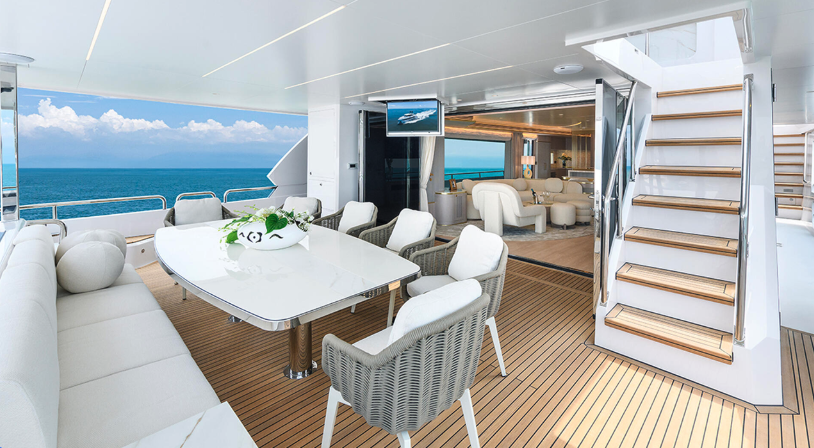
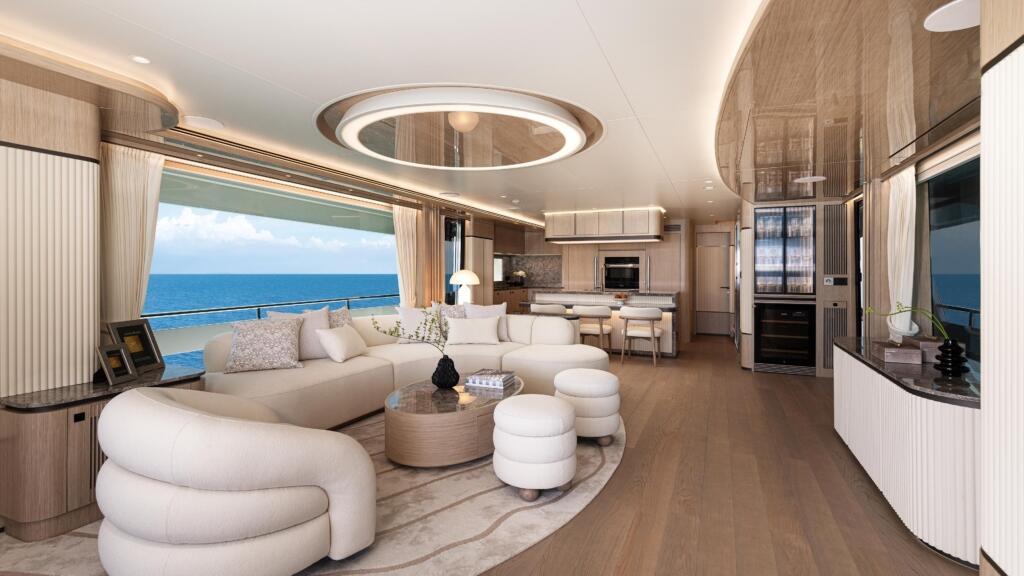
The FD80’s resale strength begins with interior volume that feels closer to an 85-foot yacht than most 80-footers in its price range. The 22-foot beam combined with intelligent vertical space utilization creates genuine full-beam staterooms without the compressed feeling sometimes found in European designs prioritizing exterior styling over interior livability.
I’ve compared the FD80’s interior layout directly against the Princess Y85 and the Sunseeker 88, and what distinguishes the Horizon is layout intelligence: how the galley flows naturally into the dining area, how the master stateroom balances sleeping space with wardrobe capacity, how crew quarters achieve proper separation without sacrificing storage access.
That functional intelligence translates directly into resale appeal. Buyers evaluating brokerage FD80s often arrive from smaller yachts where space felt compromised at every turn.
Build Quality and Taiwan Shipyard Reputation
Horizon Yachts has cultivated a decades-long reputation for systematic construction quality and responsive post-delivery support. I’ve inspected engine rooms on 2017 models that still present remarkably clean—proper drainage systems throughout, accessible service points, color-coded wiring, and logical component placement that simplifies maintenance procedures.
The FD80 employs a modified semi-displacement hull that settles comfortably at 10–12 knots for efficient long-range cruising and pushes to 16 knots when schedules demand. That design philosophy means hull structures age gracefully, and mechanical systems operate within rather than beyond their design parameters.
Taiwan shipyard construction also delivers more competitive pricing for equivalent build quality compared to European alternatives. A buyer comparing a used FD80 against a similarly aged Azimut Grande will discover the FD80 offers comparable craftsmanship at 15%–20% lower pricing.
Annual Operating Costs for a Horizon FD80
Purchase price is one-time. These costs repeat every single year and determine whether yacht ownership fits your lifestyle and budget.
Dockage and Marina Fees by Region
Mediterranean (High Season):
Prime locations (Palma, Antibes): $70,000 – $90,000/year
Annual contracts with established marina networks typically save 15-20% compared to transient daily rates. Owners who commit to 10-month terms can negotiate significantly lower effective monthly rates.
Major service every 3-5 years: $80,000 – $120,000 (engine overhauls, stabilizer service)
FD80s equipped with CAT marine engines generally require service intervals around 500 hours for minor work and 2,000 hours for major overhauls.
Crew Costs:
Professional Captain (Full-Time): $60,000 – $75,000/year plus benefits
Freelance Captain: $350 – $600/day
Most FD80 owners using the yacht 40-100 days/year hire captains on a daily basis rather than maintaining full-time crew
Fuel Consumption: At 10–12 knots, the FD80 consumes approximately 22–28 gallons per hour with twin CAT installations. Budget $25K–$40K annually for 200–300 hours of typical cruising.
Total annual ownership cost: $180,000–$260,000 for moderate usage (200–300 hours per year)
Horizon FD80 Depreciation and Resale Value
Smart buyers understand depreciation patterns before purchasing—it’s the hidden ongoing cost beyond annual operations.
5-Year Depreciation Analysis
Scenario 1: Buying New in 2025
Purchase price: $6.5M
2030 estimated value: $5.0M-$5.4M
Total depreciation: $1.1M-$1.5M (17-23%)
Average annual depreciation: $220K-$300K
Scenario 2: Buying 2020 Model in 2025
Purchase price: $5.3M
2030 estimated value: $4.2M-$4.6M
Total depreciation: $700K-$1.1M (13-21%)
Average annual depreciation: $140K-$220K
The math clearly favors used purchases. Buying a 3-5 year old model typically delivers better total cost of ownership because the steepest depreciation drop has already occurred.
Best Time to Buy an Horizon FD80
Optimal buying window: November-February
Off-season timing creates motivated sellers. Yacht show season concludes, inventory increases, and sellers face approaching winter costs. January listings historically average 8-12% lower than June peak-season prices according to Boat International market analysis.
Secondary opportunity exists September-October at Mediterranean summer season end when owners realize actual usage fell short of plans.
Is the Horizon FD80 Right for You?
The FD80 occupies a unique position: spacious enough for serious cruising but manageable without full-time crew.
Private Family Cruising
Ideal for 2-3 couples, 50-100 days annually, weekend trips plus extended voyages. The four-cabin layout accommodates guests comfortably. Hire captains per-trip rather than full-time.
Offset costs with 6-10 charter weeks annually. Professional management handles operations. However, management fees consume 25-35% of gross revenue, and charter use increases maintenance costs $20K-$30K annually.
Financial reality: Net offset to ownership costs: $80K-$150K/year
Final Thoughts
The FD80 represents a thoughtful choice in the 80-foot category—not the flashiest yacht on the dock, but one of the most dependable for buyers who value space, build quality, and predictable ownership costs over badge appeal.
In 2025, budget $4.0M-$6.8M for purchase depending on year and condition, plus $180K-$260K annually for operation. The smartest buyers focus on 2019-2021 models with under 600 hours, verify complete service records before offers, and time purchases during off-season months when negotiating leverage favors buyers.
If you want to keep cruising, here are a few earlier posts worth sailing back to.