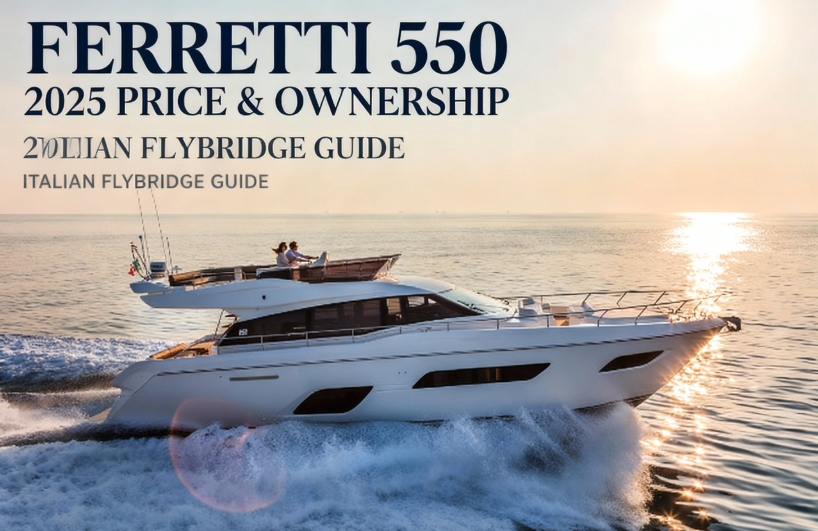
It’s easy to get lost in the romance of a Ferretti 550—the bronze window tints, the leather smell, the Italian flair. But earlier this week, I had to pull a client back from the romance to look at the math. We were comparing two 2018 listings in the Mediterranean. On the surface, the pricing seemed backward: the boat with higher usage (1,150 hours) was asking $1.64M, while its sistership with only 720 hours sat at $1.58M.
Few years ago, I would have told you to grab the low-hour boat immediately. But today, the ferretti 550 price dynamic has shifted. The more expensive boat had a factory hardtop and a Seakeeper; the cheaper one didn’t. In this market, comfort technology now often outweighs engine hours. Here is how that logic breaks down.
Current Market Valuation: Real Transaction Numbers
Brokerage Ranges (2016–2020): What’s a Fair Offer?
In today’s market, a clean Ferretti 550 from 2016–2020 typically transacts in the $1.2M–$1.9M band, with nuance by year and spec:
2016–2017: Often $1.20M–$1.45M. Sub-1,000 engine hours, good service records, updated electronics, and recent soft goods pull toward the top of the range. Heavy-hours boats (1,200–1,800 hrs) or those due big services trend toward the lower-$1.2Ms.
2018: Commonly $1.35M–$1.65M depending on hours, stabilizers, hardtop, and tender/garage fit-out. 2018 is a sweet spot for depreciation vs. spec maturity.
2019–2020: $1.55M–$1.90M. Late-2019/2020 examples with Seakeeper, hardtop, and fresh cosmetics can command closer to $1.8M–$1.9M, especially with sub-800 hrs and complete records.
Regionally, the Med typically presents more supply (slightly softer asks), while the U.S. market tends to ask stronger, sometimes $50K–$120K higher for comparable boats, because of demand, import duties already paid, and survey/registry convenience. Good Asia-Pacific examples can be thinner on the ground: shipping into the U.S. or Med usually nets out the arbitrage once transport and duty are added.
For offers: I’m frequently seeing 4–8% off firm, well-spec’d boats and 8–12% off listings that show deferred items (teak sanding, batteries, canvas, sat-domes, overdue MAN services). Fairness isn’t just the final number, it’s the logic behind pending services and spec.
The “Italian Premium”: How Stabilizers & Hardtops Shift Value
On the Ferretti 550, factory Seakeeper and a proper hardtop are genuine value drivers. Seakeeper installations generally added $80K–$150K to the original build cost: on resale, the uplift is often $60K–$100K versus non-stabilized sisterships. The fixed hardtop adds shade, weight up high, and a cleaner look than canvas, many buyers will pay a $40K–$70K premium for it, more in sunnier markets. Together, they can move a boat an entire bracket: a 2017 without both may sit at $1.30M–$1.38M, while a similar-hour boat with both can justify $1.45M–$1.55M.
Why? Comfort. The 550’s hull is confident, but the Seakeeper changes the real-world feel at anchor and on beam seas. And a hardtop turns the flybridge into a true second salon. Buyers feel that in the first five minutes aboard, and so do later buyers when you resell.
The Cost of Ownership: Running a Ferretti 550
Fuel Burn & Efficiency: MAN i6-800 Performance Data
Most Ferretti 550s in this era run twin MAN i6-800s. In my notes from sea trials:
Fast cruise (22–25 knots): typically 58–72 gph total, sea-state dependent. I commonly see 0.33–0.40 nmpg at 23–24 knots.
WOT (30-ish knots in light ship): 85–95 gph total, rarely used in practice.
Trim tabs and load matter. A hardtop, full water, tender on the platform, and a week of provisions can push burn up by 5–10%. Detailed performance specifications are available in the MAN i6-800 technical data sheet.
Annual Maintenance Budget: Engines, Teak, and Interior Care
Annual maintenance usually sits around $30K–$50K for an actively cruised 550, excluding moorage/insurance. Line items I plan for:
Engines/genset: $8K–$15K annually for routine service, plus MAN interval work (valves, coolers) per hours/years. Budget extra in heavy-hour years.
Teak/care: $3K–$7K for cleaning, brightening, and spot repairs: a full sand can push higher if overdue.
Stabilizer service: $1.5K–$3K annually: major overhauls are multi-year events.
Electronics and nav: $1K–$3K for updates, plotter software, failed sensors.
Interior/upholstery/soft goods: $2K–$6K depending on use and climate.
Insurance varies widely by region and experience. In the U.S., I’ve seen $12K–$25K per year for well-qualified owners: the Med can be similar, sometimes slightly softer for marina-based boats.
Market Comparisons: Is the Ferretti 550 Your Best Buy?
Ferretti 550 vs. Azimut 55: The Battle of Style
Azimut leans lighter, airier, and sometimes flashier. The 55’s glazing is dramatic and the salon feels visually larger. Ferretti counters with calmer ergonomics, thicker-feeling joinery, and a more measured ride feel at speed. On price, late-2010s Azimut 55s often ask slightly less in the Med, narrowing in the U.S. once duty and transport enter the picture. Stabilizers are the swing factor: a stabilized Ferretti 550 tends to hold its number better at resale, while non-stabilized Azimuts can linger unless priced decisively.
Ferretti 550 vs. Sunseeker Manhattan 52: Volume vs. Layout
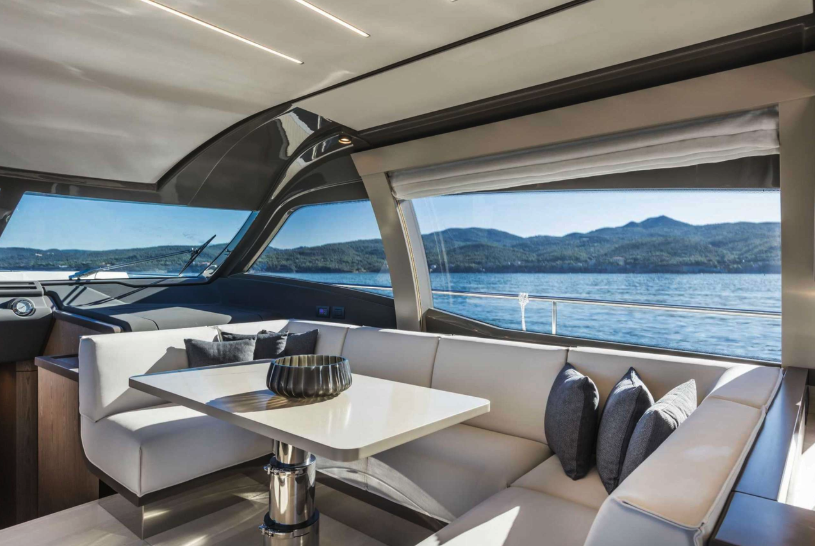
The Manhattan 52 usually comes in a touch less on price for similar years, and it offers clever volume for its length. I find the Sunseeker helm ergonomics a bit sportier, with a livelier throttle feel. The Ferretti 550’s edge is layout flow, galley and salon connectivity feel serene, and noise levels at 22–24 knots are pleasantly subdued. If your priority is a calmer, more grown-up interior aesthetic with solid resale, Ferretti gets the nod. If nimble handling and slightly lower acquisition cost matter more, Manhattan 52 is a smart foil.
Dora’s Buying Advice: Where the Smart Money Goes
Depreciation Curve: Why 2017–2018 Models Shine
Early-year depreciation on this class typically runs 12–18% in the first two years, then flattens. By 2017–2018, much of the initial drop has already been taken, electronics are modern enough to live with, and hull/fit refinements from the earliest builds have settled. That’s why the 2017–2018 Ferretti 550 often delivers the best value: mature spec, not too old for refit drag, and still attractive at resale. If you’re tracking “ferretti 550 price” with a long view, those years tend to be the liquidity sweet spot. Boat International regularly covers depreciation patterns across this segment.
Survey Checklist: Glazing, Hydraulics, and Service History
A few buyer-side notes from recent inspections:
Glazing and seals: Check for UV haze and micro-leaks around salon glass and hull windows, costly cosmetically if ignored.
Hydraulics: Swim platform rams and passarelle actuators deserve a slow, full-cycle test. Any twitchiness, note it for allowance.
MAN service history: Confirm cooler/aftercooler intervals by date and hours, not just stamps. I like compression and boroscope data on higher-hour boats.
Electrical loads: With Seakeeper, all A/Cs, and galley appliances running, watch voltage steadiness and genset behavior.
Teak and deck hardware: Look at step edges and high-traffic seams first: they reveal real use patterns.
Field note: I saw three 2017 units last month in Palma: the one with meticulous MAN records and a modest electronics refresh sold first, even though being mid-pack on hours. Good paperwork still outperforms pretty photos.
Closing thought: Choose the boat that’s already configured the way you’ll actually use it, stabilizers, hardtop, tender handling, because retrofits are pricier than they look on spreadsheets. Pay for the right features once, and the market will usually pay you back later.