Think about how you really spend time on a 60-foot flybridge yacht.
Do you linger at anchor, set out loungers, open the windows wide, and treat the cockpit as your living room? Or do you run miles between islands, value tracking, visibility, and low-noise cruising days?
Those two habits lead you toward two very different boats.
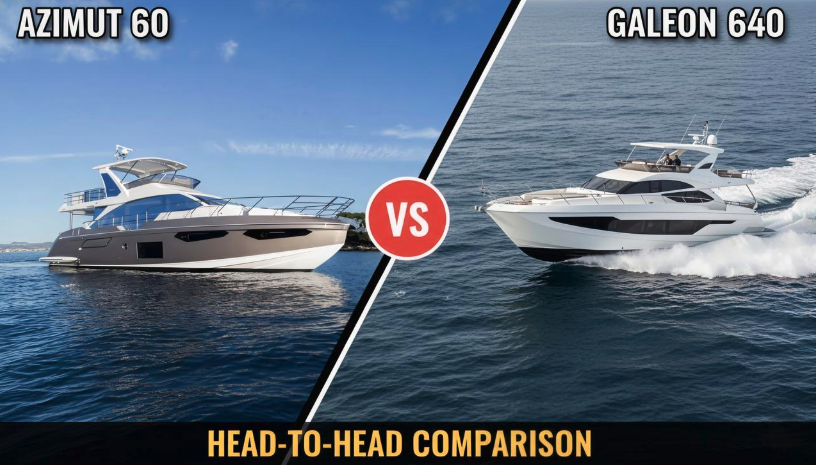
Galeon leans into beam, volume, and transformable space. Azimut leans into balance, ergonomics, and refinement underway.
Only after that does the price picture make sense: the 2019 Azimut 60s around $1.7M, the 2019–2020 Galeon 640 Flys frequently $2.2M–$2.6M. The gap is simply the cost of choosing space versus motion, volume versus composure.
That’s the real way to weigh these two in 2025.
Azimut 60 vs Galeon 640 Fly: Price and Value Comparison
On price, these boats live in adjacent, though not identical, neighborhoods. The Azimut 60 typically ranges from about $1.3M–$2.2M on the brokerage market depending on year, hours, and spec, with most 2018–2022 boats clustering around $1.6M–$1.9M. A well-kept 2023–2024 example with low hours and a Seakeeper often stretches north of $2.0M. New build replacements, optioned sensibly, commonly sit in the mid–$2Ms.
The Galeon 640 Fly is a larger, heavier platform, and pricing reflects that. Late-2010s to early-2020s boats frequently list between $1.9M–$3.0M, with high-spec, low-hour 2021–2023 units in the $2.4M–$2.8M corridor: fresh builds with premium packages can move into the low–mid $3Ms. You’re buying more volume and the brand’s signature transformable deck architecture.
Why the variance? Year → engine hours → stabilization → electronics generation → regional demand. Early-year depreciation on both tends to run roughly 12–18%, easing to ~6–10% annually after the first 3–4 years, then flattening as the market finds equilibrium. Regionally, the Med favors entertainment space, so Beach Mode Galeons often command stronger pricing there: the U.S. rewards clean service records and strong dealer support, Azimut’s network helps hold values stateside. Asia typically shows fewer listings and a premium for low hours and turnkey condition.
Annual running costs for either, realistically: $80K–$150K with moorage, insurance, routine service, and a stabilization system in the mix. Retrofit stabilizers generally add $100K–$180K: upgraded electronics packages, $25K–$60K. These line items materially affect asking prices and liquidity at resale.
Innovation vs Style
Azimut leans toward refined lines, weight-managed construction, and interiors that feel curated rather than configurable. Galeon leans into clever spatial engineering, folding bulwarks, opening salon windows, sliding modules, that re-stage the boat for different moments at anchor. Neither approach is better in the abstract: they simply serve different habits.
Galeon’s “Beach Mode” vs Azimut’s Carbon Tech Construction
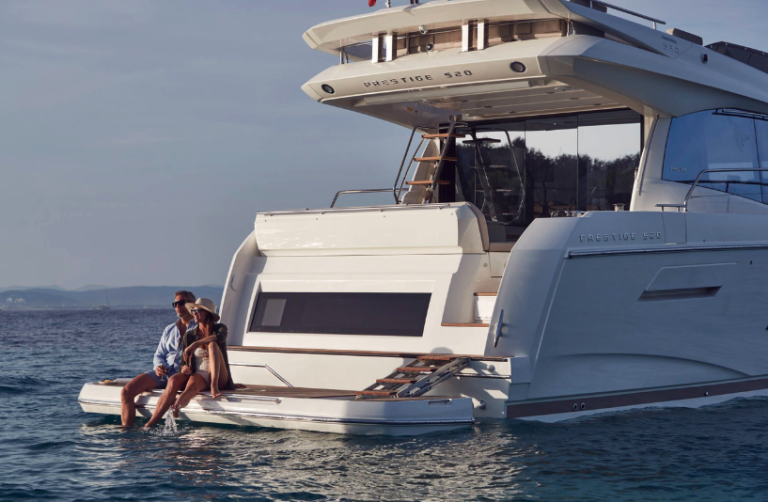
Galeon 640 Fly official features include the signature “Beach Mode,” which turns the cockpit into a waterside terrace by dropping the port and starboard bulwarks. It’s transformational, especially in coves. It also adds weight and mechanical complexity. Properly maintained, it’s brilliant: deferred service can show up as alignment and latch issues on survey.
Azimut official technical specifications highlight how their Carbon Tech (carbon fiber in the superstructure and hardtop) reduces weight up high and helps the 60 feel a shade more poised underway. It also supports flybridge layouts without making the boat top-heavy. In resale terms: Beach Mode photographs and shows dramatically, drawing Med buyers. Carbon Tech quietly benefits seakeeping, fuel economy at cruise, and long-run rigidity, appealing to buyers who value the way a boat moves through water as much as the way it entertains at anchor.
Performance and Fuel Efficiency
Real-world numbers, not brochure gloss: The Azimut 60 with Volvo Penta D13 specifications typically cruises in the 24–27 knot band and tops around 30–32. At a comfortable 24–25 knots, you’ll commonly see fuel burn roughly in the 60–75 gph range depending on load, sea state, and bottom condition. The lighter superstructure helps her track cleanly with a calmer roll moment when the stabilizer is on.
The Galeon 640 Fly, usually on Volvo D13 1000s or similar, is a bigger displacement. Expect a 23–26 knot cruise and ~30–32 knots WOT. Fuel at a typical 24-knot cruise often sits in the 80–95 gph range. She feels planted, with a reassuring, slightly heavier motion that some guests prefer. If you’re a 10–12 knot displacement cruiser, both boats settle nicely, but the 640’s volume makes slow cruising particularly relaxed.
Stabilization: both see Seakeeper stabilization systems fitments frequently: gyro sizing and placement matter. A properly sized unit improves enjoyment and resale: undersized or tired gyros show up in sea trials and negotiations.
Interior Volume and Layout Differences
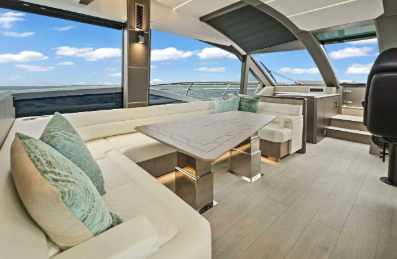
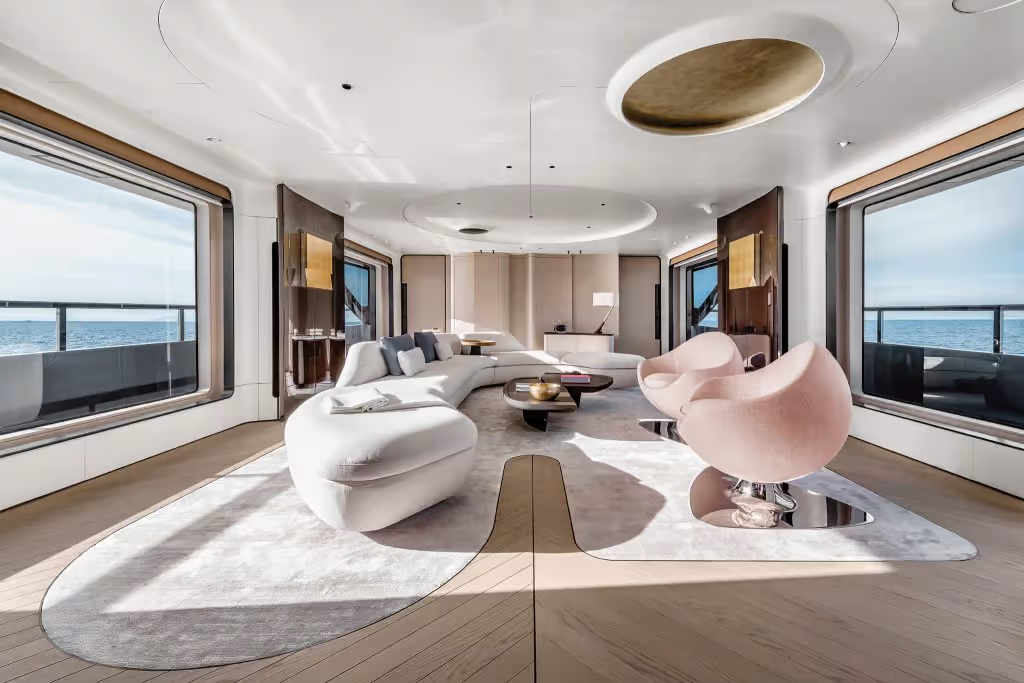
I’ve walked these models back-to-back more times than I can count, and the feeling is consistent. The Galeon 640 Fly delivers a bigger-boat experience: broader salon sightlines, a more open galley/cockpit interface when the windows are slid away, and that expandable beam at anchor. The master often reads apartment-like, with headroom that surprises first-time visitors.
The Azimut 60 counters with proportion and polish. Salvagni’s interiors avoid clutter: the joinery, hardware feel, and lighting layers are quietly premium. Traffic flow, helm to galley to cockpit, feels intuitive underway. Noise levels at a mid-20s cruise are impressively low for the class, and the helm ergonomics tend to suit longer runs. If you host dockside or spend long weekends aboard, the Galeon’s transformable spaces are wonderful. If you actually move the boat often, the Azimut’s composure and human-scale layout are easy to live with.
Berths and heads are competitive: crew arrangements vary by spec. I look closely at window seals, latch feel, and sole squeaks on both, small tells about build consistency and use.
Which 60-Foot Flybridge Offers Better Value in 2025?
It depends on how you use it.
If you anchor-out and entertain: the Galeon 640 Fly’s Beach Mode and open aft galley make every cove feel like a private club. Pay for condition and clean Beach Mode mechanics. Expect slightly higher fuel and maintenance overhead.
If you run more miles and value underway manners: the Azimut 60’s lighter superstructure, balanced ergonomics, and calmer motion at speed deliver day after day. Pay for low hours, gyro fitment, and up-to-date electronics.
Value lens: In 2025 the Azimut 60 generally offers a lower acquisition cost and steadier liquidity in the U.S.: the Galeon 640 Fly commands a premium for space and theater, especially in Med markets. Depreciation curves are similar: resale favors boats with thorough records, gyro stabilization, and fresh cosmetics.
Compare Live Azimut 60 and Galeon 640 Fly Listings
When I line up live listings, I score them on a single page:
Hours bands: <500, 500–1000, 1000–2000. Each step down adds scrutiny, cooling systems, exhaust, mounts.
Stabilizer: installed, size, service history. Gyro hours and service dates matter.
Electronics generation: modern glass bridge vs mixed legacy units: autopilot and radar age.
Survey tells: moisture readings around window lines, deck hardware bedding, Beach Mode alignment on the 640.
Running-cost clues: recent bottom job, propscan, heat exchangers, and exhaust service dates.
Regional context: Med boats with Beach Mode often photo better and price stronger: U.S. boats with dealer service histories trade faster.
One dependable principle: buy the cleaner example of the platform that matches your real usage, not the cheapest of the larger choice. Condition beats footage, every time.
If you’re in the mood for more, here are a few posts you might enjoy next.