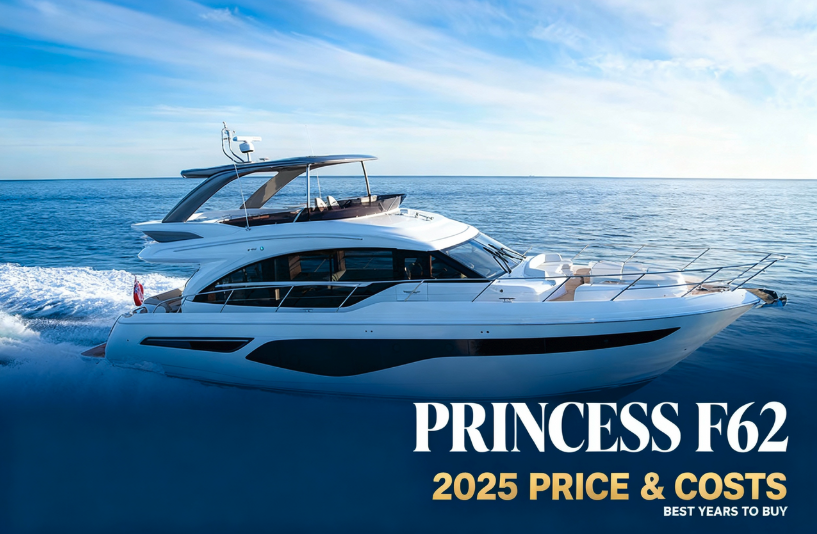
Yesterday, a client forwarded me a listing for a 2019 Princess F62 in Palma, asking the question that stops almost every buyer in their tracks: ‘Why is this nearly $400k less than the one we looked at in Fort Lauderdale?’ It’s a fair question. On the surface, they are the same boat—similar hours, same lovely lines. But when you peel back the layers of location, ‘US Specs,’ and the hidden costs of importation, that price gap tells a very specific story. If you are trying to make sense of the Princess F62 market in 2025, here is the reality behind the numbers.
2025 Market Snapshot: Current Princess F62 Price Ranges
Breakdown by Model Year (2017–2019 vs. 2020–2022)
The Princess F62 ran from roughly 2017 through the early 2020s before the F65 took the baton. As of 2025, I typically see:
2017–2019: often ranges between $1.55M and $1.95M, depending on hours, condition, stabilizers, and whether a hardtop is fitted. Clean 2019 boats with Seakeeper and sub‑1,000 hours tend to sit in the $1.8M–$1.95M band.
2020–2022: generally $2.05M to $2.55M, with late‑spec, low‑hour, hardtop + Seakeeper examples occasionally pushing $2.6M–$2.7M. The very best curated boats (warranties carried forward, impeccable records, fresh electronics) can justify the top end.
Why the step-up? Newer interior refreshes, updated electronics suites, and higher-option builds. There’s also simple scarcity: late F62s are fewer, and some buyers prefer the last-of-line maturity before a model change.
The “Location Gap”: Why US Models Cost More than European Listings
U.S. ask prices usually run 6%–12% higher versus comparable Mediterranean listings. Three reasons show up over and over:
Spec bias: U.S. boats more often carry Seakeeper gyros, hardtops with opening roofs, upgraded tropical air, and larger generator packages, options that materially improve day-to-day use and resale.
Import/friction costs: Duty, logistics, and post‑shipment punch‑lists add up. Even if a boat already sits in the U.S., that history is “priced in.”
Demand density: Florida and the Northeast create faster absorption for clean 60–70 ft flybridges. Softer time-to-sale in parts of Europe translates into slightly lower asks there.
If you’re open to importing from Europe, pencil in roughly $120K–$180K for survey, shipping, cradle, insurance-in-transit, duty (where applicable), and commissioning. The math still works for certain well-bought boats, but the cushion shrinks quickly if you need heavy remedial work on arrival.
The Real Cost of Ownership (Beyond the Purchase Price)
Mooring/berth: in major U.S. hubs, expect $22K–$45K per year: prime marinas can run $50K+. Med seasonal contracts vary widely, €18K–€40K is common for this size, with location doing most of the talking.
Insurance: typically 0.7%–1.2% of agreed hull value. On a $2.1M F62, that’s roughly $15K–$25K, adjusted for operating area and experience.
Crew: many F62 owners run owner-operator with periodic captain support. Budget $18K–$40K annually for part‑time help, washdowns, and trip captaincies. A full‑time captain can push total crew overhead to $120K–$160K including taxes/benefits: not essential for everyone, but some families prefer the ease.
Variable Costs: Fuel Economy & Volvo IPS Service Intervals
Most F62s are shaft‑drive, commonly withMAN V8 1200s orVolvo D13s. Real‑world fuel use I’ve logged and corroborated:
Displacement/slow cruise (9–10 kn): about 12–18 gph combined, sea state depending.
Fast cruise (22–26 kn): typically 70–85 gph combined. Clean bottoms and fresh props matter: a dirty hull can add 10% quickly.
Service cadence for shaft setups: annual fluids/filters, impellers, zincs: 1,000‑hour MAN/Volvo majors can land $25K–$40K depending on scope and region. Stabilizer service (if Seakeeper) is modest annually but plan on periodic bearing and cooling system attention.
About IPS: the F62 isn’t an IPS boat, but many buyers cross‑shop IPS flybridges. For context, IPS pods usually want 250‑hour pod services and 2‑year seal inspections: budget roughly $6K–$10K per visit on a twin‑pod setup. If you’re moving between IPS and shafts, align your expectations accordingly, shafts bring simpler underwater gear, IPS brings joystick precision and different maintenance rhythms.
Why Prices Vary: Dora’s Inspection Field Notes
Impact of Engine Hours and Maintenance Records on Value
Hour bands tell a story. I’ve seen tidy 2018 F62s with 1,400–1,700 hours still command strong offers because the logs were immaculate and the engines ran beautifully under load. As a rule of thumb:
300–800 hours: premium territory if records are complete.
800–1,400 hours: neutral band: condition and service discipline decide value.
1,500+ hours: I slow down and probe, cooling system history, injector work, turbo condition, exhaust lagging, and gearbox temps. Price adjustments here can be 4%–8% versus low‑hour peers, sometimes more if majors loom.
Essential Options That Command Higher Prices (Seakeeper & Hardtop)
Seakeeper gyro stabilization and a factory hardtop with opening sunroof consistently add resale elasticity. On comparable boats, I often see:
Seakeeper: +$60K–$120K in achieved price, more in the U.S. where weekend chop makes gyros feel indispensable.
Hardtop: +$50K–$100K depending on execution and canvas alternatives. Buyers value shade and clean antenna integration.
Assessing Condition: Common Wear Points in the Galley and Cockpit
Three areas I always linger:
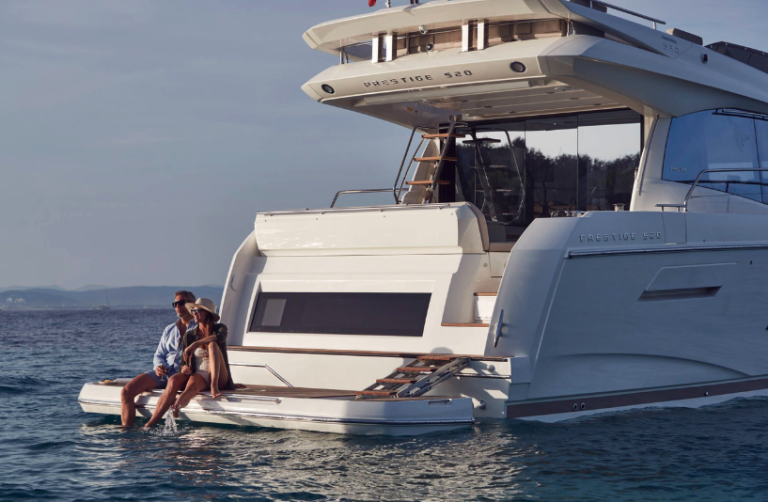
Teak seams at the cockpit and platform edges, look for caulking shrinkage and lifted nibs near the transom corners.
Galley hardware: fridge/freezer latch fatigue, soft‑close drawer alignment, and induction cooktop glass micro‑chips from cookware.
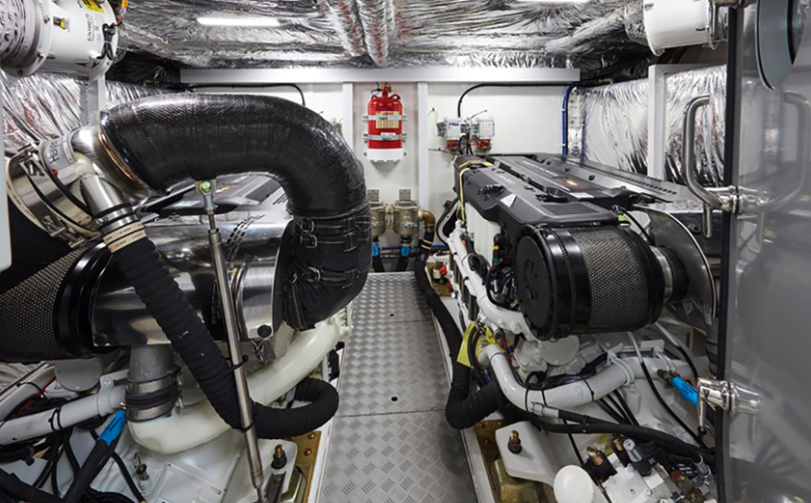
Exterior upholstery: flybridge helm seats and aft bench sun exposure: UV tells you more than the hour meter sometimes. Also check engine‑room insulation panels for moisture wicking around penetrations.
The Princess joinery in the F62 is generally excellent, tight veneers, smart grain matching. When it’s been cared for, it ages gracefully and reads “quality” even before you start the engines.
Quick Comparison: F62 vs. Sunseeker & Azimut
How the F62 Competes on Value and Interior Volume
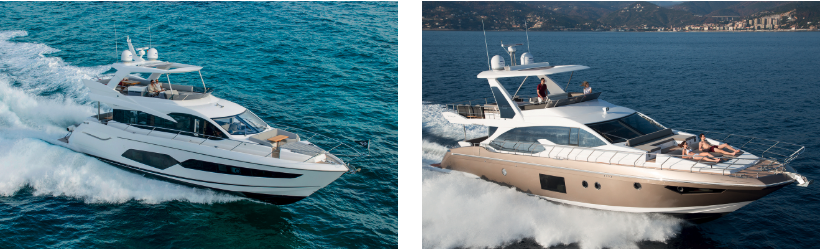
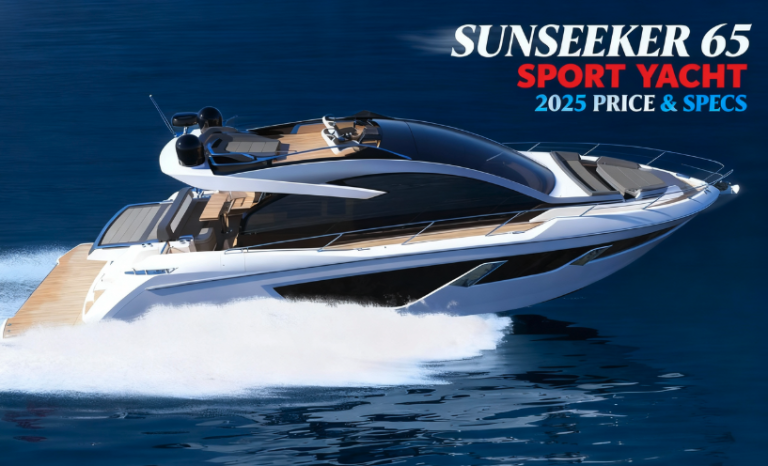
Against a Sunseeker Manhattan 66 and Azimut 66 Fly, the F62 sits in a sweet spot:
Value: Manhattan 66s in the U.S. can ask slightly higher when similarly optioned: Azimut 66s often transact a touch lower on the secondary market due to faster early depreciation. The F62 typically threads the middle, solid demand, sensible running costs, and steady resale.
Interior volume: Princess uses space elegantly, good headroom, a practical galley‑up, and a comfortable full‑beam owner’s cabin. Not the absolute biggest in class, but it feels balanced and ergonomic. Traffic flow from cockpit to salon is calm and readable.
Ride/engineering: the F62 hull feels planted at fast cruise with a reassuring, quiet machinery space. Sunseeker brings a sportier edge: Azimut emphasizes styling and light. Pick your priorities, but if you value refined finish with low drama underway, the F62 makes a strong case.
If you want a 60–65 ft flybridge that favors craftsmanship, ride quality, and thoughtful options over flash, the F62 is still a lovely buy. I’d steer:
Value‑seekers to 2018–2019 hulls with 800–1,200 hours, complete service histories, and Seakeeper. Expect ~$1.75M–$1.95M asked, with fair negotiation room on survey findings.
Late‑model hunters to 2021–2022 boats with hardtop + gyro and refreshed electronics, typically $2.2M–$2.6M. Scarcity supports these prices.
One dependable principle: buy the best maintenance story you can verify. Hours matter, but disciplined care and correct upgrades protect you better than chasing the cheapest ask.
Frequently Asked Questions
What is the average fuel consumption of a Princess F62?
At an easy 9–10 knots, expect roughly 12–18 gph combined. At a typical fast cruise of 22–26 knots, plan on 70–85 gph, varying with load, sea state, and bottom condition.
How much does a Princess F62 depreciate per year?
Early ownership years are already past for most F62s, so depreciation is gentler now, often 6%–9% annually in today’s market, with well‑kept, high‑spec boats on the lower side of that range. Poor records or upcoming majors can push it higher.
Is the Princess F62 expensive to maintain compared to similar flybridges?
It’s competitive. Annual routine care (excluding majors) typically sits around $25K–$40K for a regularly used F62. MAN/Volvo 1,000‑hour services and gyro maintenance are the bigger episodic items: priced fairly against peers from Sunseeker and Azimut, with the F62 benefiting from straightforward shaft‑drive simplicity on most builds.